

Legislative Priorities Overview
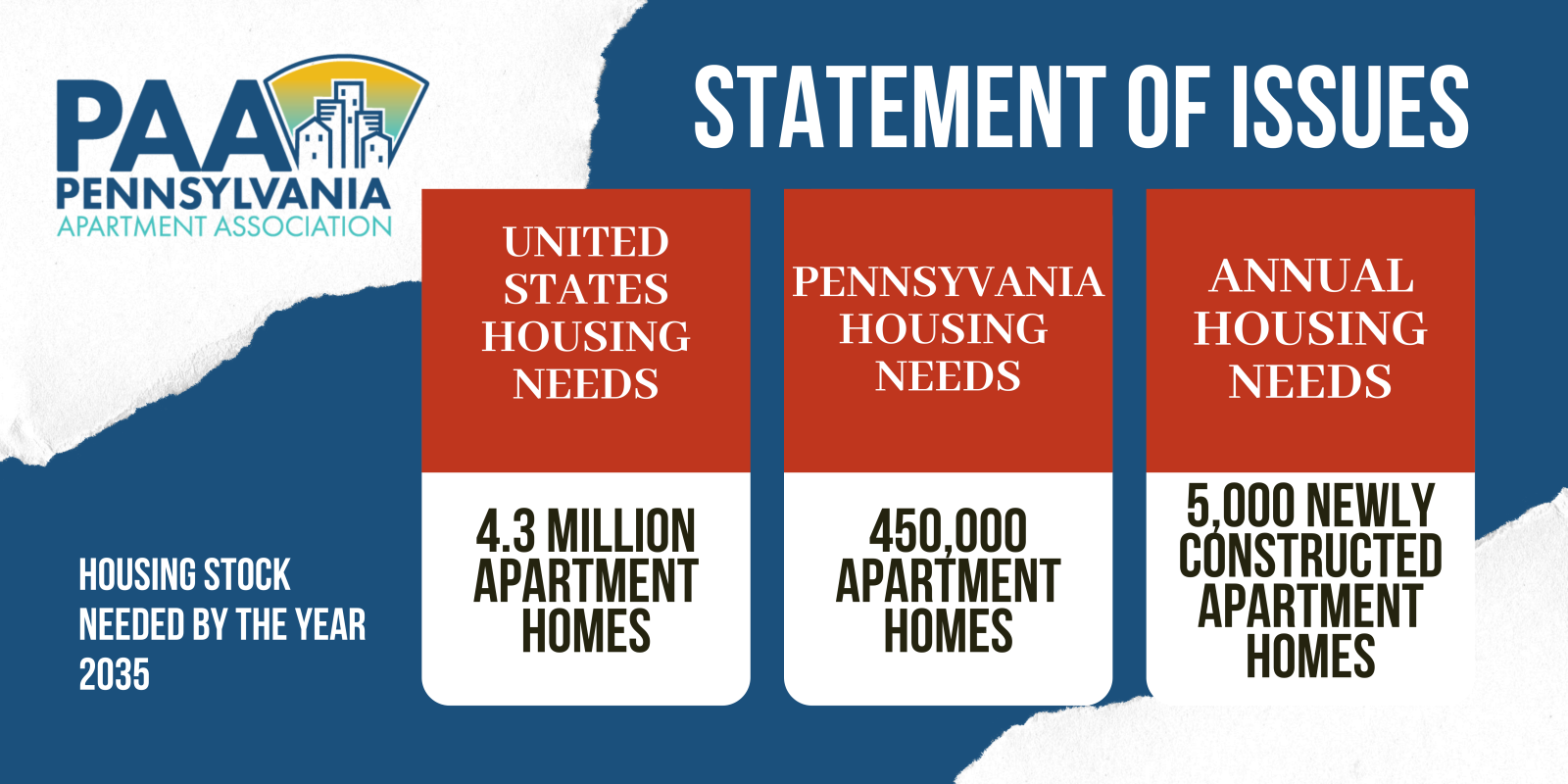
The U.S. needs to build 4.3 million new apartment homes by 2035 to meet the
demand for rental housing and address affordability challenges. This includes
an existing shortage of 600,000 apartments stemming from under-building in
the aftermath of the 2008 financial crisis. The Pennsylvania Apartment
Association stands with our national organization in supporting measures that:
The U.S. needs to build 4.3 million new apartment homes by 2035 to meet the
demand for rental housing and address affordability challenges. This includes
an existing shortage of 600,000 apartments stemming from under-building in
the aftermath of the 2008 financial crisis. The Pennsylvania Apartment
Association stands with our national organization in supporting measures that:
The Pennsylvania Apartment Association stands with our national organization in supporting measures that:
- Reduce barriers to new apartment construction that are often imposed at the state and local levels of government.
- Reduce the use of exclusionary land use policies like zoning and density restrictions, onerous parking requirements and other regulations that exacerbate both housing supply and affordability challenges.
- Promoting pro-housing policies aimed at greater production and preservation of affordable housing, and reporting ways in which adopting these policies, will benefit the localities in promoting the development of affordable housing.
Reducing barriers to development is a core strategy in addressing housing affordability challenges in our communities. Housing affordability is a complex issue that is best remedied by solutions that increase the supply and availability of rental housing at all price points. It is critical that our cities reduce regulatory and economic obstacles to the development of new housing.
POLICY POINTS:
Opposing Rent Control:
Rent control is a government-enforced limit on the rents that property owners may charge in private, market rate rental housing. This policy is known by various terms, rent stabilization, rent freeze, rent caps, and anti-price gouging. Decades of empirical research have demonstrated that these policies distort the housing market by discouraging the construction of new rental units and the upkeep of existing ones. With limited or no potential for profit, investors often redirect their capital to areas without rent control.
Ultimately, rent control disrupts the housing market by discouraging new rental housing development and hastening the deterioration of existing units. The PAA maintains that, over time, such policies undermine the very communities they are intended to help by reducing both housing availability and affordability.
Increasing Housing Supply Through Regulatory Reform:
Pennsylvania cannot solve its housing affordability crisis without addressing the local zoning and regulatory barriers that limit housing production. The Pennsylvania Apartment Association strongly supports modernizing local planning, permitting, and zoning policies to enable the development of more multi-family and diverse housing types in communities across the Commonwealth.
- Unlock Transit-Oriented Development:
Targeted rezoning around subway, light rail, and commuter rail stations can quickly expand housing supply where demand is highest. Allowing 3- to 5-story apartment buildings near transit hubs creates lower-cost housing options, reduces transportation costs for. residents, and supports economic growth by connecting workers to job centers.
- Enable Higher-Density Housing Where it Makes Sense:
Outdated zoning codes that restrict density remain one of the largest barriers to housing affordability. National housing experts consistently find that low-density zoning drives higher housing costs, while well-planned, higher-density development improves affordability and land efficiency. Allowing duplexes, triplexes, fourplexes, and mid-density multifamily housing provides more attainable housing options without altering community character.
- Expand By-Right Housing Development:
Zoning reform must include expanding by-right multifamily zoning and permitting small-scale multifamily housing in areas currently limited to single-family use. These reforms allow housing to be built near existing infrastructure, transportation, and employment centers—supporting workforce housing and reducing development delays and costs.
- Revitalize Underused and Blighted Properties:
Pennsylvania has an opportunity to turn struggling properties—such as vacant malls, aging office parks, and underutilized commercial sites—into thriving residential communities. Updating zoning laws to allow multifamily and mixed-use development in areas already served by water and sewer infrastructure can spur reinvestment and neighborhood revitalization while minimizing taxpayer costs.
- Support Municipal Flexibility and Smart Local Planning:
Municipalities need tools—not mandates—to implement housing strategies tailored to local needs. State programs like the Pennsylvania HOME Program already help communities expand and preserve affordable housing through grants and loans, and zoning reform can amplify the impact of these investments.
- Advance Bipartisan, Common-Sense Solutions:
PAA supports bipartisan efforts—such as legislation advanced by Senators DiSanto and Saval—that allow manufactured housing and accessory dwelling units by right in single-family zoning districts, permit medium-density housing in larger municipalities, and prevent excessive minimum lot size and parking requirements from undermining affordability.
The bottom line is that zoning reform is essential to increasing housing supply, stabilizing costs, and ensuring Pennsylvania communities can grow and compete. By modernizing outdates regulations and embracing a full range of housing options, the Commonwealth can expand access to safe, affordable housing while strengthening local economies.
Supporting Funding for Housing Production & Preservation:
Promote robust state investments in flexible housing funding tools such as the Pennsylvania Housing Affordability and Rehabilitation Enhancement Fund (PHARE), housing repair funds, and capital programs that help build and preserve rental units.
Promote Balanced Renter Protections:
Engage in policy discussions on renter protections that stabilize housing for residents while safeguarding housing providers’ rights and minimizing impacts on rental housing operations.
Ensure Tax Policy Supports and Promotes Investment in Multifamily Housing Across all Types and Price Ranges:
Tax policies that promote investment in multifamily housing are essential for building a more balanced, sustainable, and inclusive housing market. These policies support the development of housing at various price points, addressing the needs of a diverse population, driving economic growth, reducing inequality, and ensuring that communities have access to affordable, quality housing options.
Preserve the Use of Artificial Intelligence and Algorithm-Based Technologies Within the Housing Industry:
Maintain the use of artificial intelligence and algorithm-driven technologies in the industry. When applied responsibly, these tools optimize and modernize traditional practices, improving operational efficiency—benefits that directly impact residents and rental communities. They allow on-site staff to prioritize relationship-building and meet the specific needs of applicants and residents.
Ensuring Historic Preservation Requirements and Other Land Use Policies Encourage Housing in Historic Buildings:
Revise historic preservation requirements alongside other land use policies by:
- Streamlining Permitting Processes:
Simplify and expedite the permitting process for housing rehabilitation projects in historic districts.
- Offering Incentives:
Provide tax credits and financial incentives for renovating historic buildings.
- Creating Flexible Design Guidelines:
Develop adaptable design guidelines that balance historic integrity with modern needs.
- Engaging Developers and Property Owners:
Foster collaboration to promote adaptive reuse of historic buildings into housing.
By implementing these strategies, we can align historic preservation with the demand for new housing, honoring heritage while meeting contemporary.
Using Property Tax Abatements to Enable Higher Density and Mixed-Income Communities:
Implementing property tax abatements can incentivize the development of higher-density and mixed-income communities, improving housing accessibility and affordability.
Advance Workforce & Middle-Income Housing Strategies:
Support policies that help moderate-income workers find and afford rental housing through public-private partnerships, workforce housing initiatives, and targeted incentives.
Encourage Energy Affordability & Efficiency for Rental Properties:
Advocate for policies that reduce energy costs for rental properties and support sustainable building practices, helping lower operational costs and improve affordability for renters.
Donate to the Political Action Committee.
Be Part of the Impact.